Backpacking in Peru 1995 |
||
The plane arrived at midnight, so it meant a night at the airport in Lima before phoning Juliet's sister April. I asked about buses to her out of town house, but she didn't use or know bus routes and ordered me a taxi. It was $40 rather than $1 for the bus but led to a safe journey for a virgin tourist and a warm welcome to a luxurious house by the sea. She had an engaging business partner, Adolpho, and a wonderfully welcoming family. We were soon on the beach. This is the life, not what the intrepid traveller usually expects. April, who had lived in Peru since travelling there as a 17-year-old was, to me, still recognisably English, but so attuned to Peruvian life that she was casually known as 'Gringo'. She also casually showed her unflappable approach to life with stories to make your toes curl. She belonged to a microlight club and had recently crashed and been injured but not deterred. She also had several tales of Lima's wild west. On one occasion, she had her windscreen smashed by a man with a rock. She chased them in her car, only to be shot at by an accomplice. All in a day's work. She told a man who tried to rob her shop "get a job". By now I was sure that I should not leave the house, especially when she described how the latest scheme of robbers was to leave large rocks in black plastic bags on the highway at night. The disabled car was then fit for robbery. Later, in spite of her accident, April introduced me to micro lighting. An hour's trip in a microlight took me over beaches and local areas in a thrilling experience with the sensation of being on a flying motor bike. This time there was no accident. Cusco April dropped me at the airport for an exhilarating flight over high mountains, seeing isolated villages, with no obvious roads, in the middle of mountains, leaving the questions, 'How did they get there?, 'How can they survive there?' 'Why stay there?' - the tenacity of humans. The plane then makes you shut your eyes as it wheels around a large mountain to descend to a small airstrip at an altitude of a mere 3,200 metres. Cusco, tourist territory, meant that I soon met an English woman who put me into a pleasant hotel, as yet to be formally opened. I was goggle eyed as I saw my first llamas in the back streets, marvelled at high block walls made of precise large blocks, ground to fit exactly with no mortar and realised that 3,200 metres was quite high and needed acclimatisation. Quechua speaking high mountains people stood shyly in groups. I wandered down a side street to a local market held next to railway lines. I was drawn towards the sound of music which took me to a scene of market people dancing. I soon found myself dancing with them, ending up with an XL lady with eight children, who danced with me until she fell over and hurt her leg. Much beer was consumed and I was not allowed to refuse - what a welcome, what a first evening. The next day was a tourist day, visiting impressive ruins and a disappointing museum. I had some sense of the nature of Inca organisation, bureaucracy and ingenuity. There was even a system of rocks and vegetation laid in layers to draw water up the mountainside. The bank was full of soldiers controlling queues. It looked like some sort of rush on the bank, but I never found out. The famous Inca trail to Machu Pichu required a guided trip and I booked for the next day but had to turn down an invitation to a remote village because of time constraints. Up at 6.30 am and the lovely concierge got up to see me off. Boys were playing football in the street before work as I walked to the bus, which was late. I climbed in to meet our small group, 2 Argentines with no English, an ICI biochemist from Reading and his Aussie lawyer partner, specialising in Aboriginal land rights, and an Aussie/Basque couple en route for Oz after 5 years in Wells, Somerset. People were not at ease with each other at first, but it turned out to be a harmonious group. We drove through the sacred valley and stopped at Urambamba for breakfast. Nothing prepares you for the magnificence of the steep valley views that will be your companion to Machu Pichu. We started the walk at 88 kms. The first day was gentle, with trails taking us high and low along the sides of beautiful valleys, past waterfalls and across small rivers. Local people appeared dirty and dispirited. A one-room stone building was kitchen and living room with a tap outside for washing. We drank pisca with cinnamon and cloves and swapped stories before an early sleep.
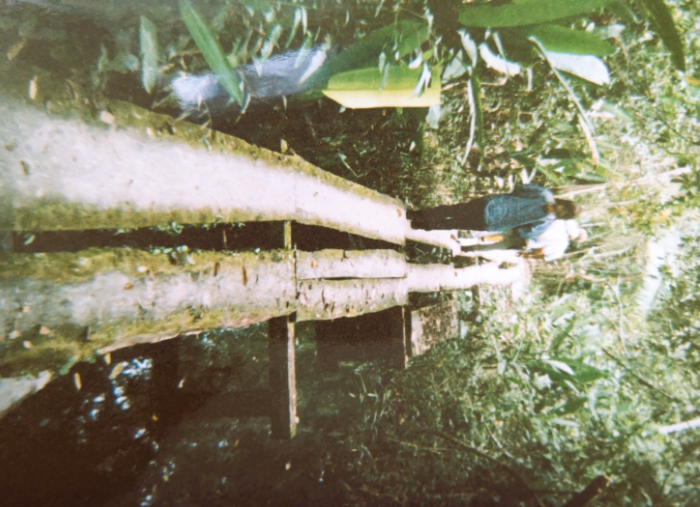
Day two started well with a climb along sub-tropical paths with trees and cascading streams. As we went higher, breathing became harder and the Argentine woman was beginning to struggle. The trail ended with a very long, steep climb to 4,200 meters. It felt like the end of a marathon. 15 km seemed a long way. At that height I found carrying my heavy pack made walking a torture. Every step was an effort, and I could not walk more than 50 metres without stopping for a breather and recovery. I saw a local catching me up further back along the trail. I felt better when I saw him stop to rest some way back, until he passed me carrying three rucksacks for tourists with less macho pretensions than me. We eventually camped by a beautiful lake to wash in with views of snow-capped peaks, although a day of heavy rain had left us all very cold. I had by now developed a theory that local people had developed a way of only walking downhill as I never saw anyone walking past uphill. During the day we had seen a mountain that was missing its peak that had collapsed down the slope during an earthquake, a reminder of our vulnerability before natural events. The next day started with the guide's motivational promise that we would be walking downhill. Of course, he failed to mention how hard downhill is on knees and feet. He did thoughtfully lay-on a cloud of dancing butterflies preceding us on the path. The vegetation-mantled vista still kept their wonder flowing. By now the group was straggling and I spent much of the day walking alone until we gathered at a campsite with a ruin and a small black snake. We couldn't ignore our tiredness and slept early. The entry to Machu Picchu is through the sun gate, which offers awe inspiring views of this wonder of the world. The Gods had decided otherwise and heavy rain and mist obscured the view. The tired group lost the will to live and mutterings about it not being worth going to the ruins started to appear. I tried to persuade them that a wonder of the world did not rely upon good weather and, having gathered themselves we made a triumphal entry into Machu Picchu. We were rewarded, almost immediately, with the sun's blessing and the sudden explosion of a Californian tour party (Vision Tours) into the sacred space. They deepened our religious experience by placing jewellery in the centre of a sun dial while a group of younger women formed a circle linking hands and closing their eyes, the better to connect with the divine. The ageing, pony-tailed swinger of a tour leader ran around taking pictures of them. Meanwhile, a native American man and a white guy were making a soppy video about two cultures meeting. Luckily, American attention spans did not last for too long. While I waited for a quiet moment, I thought it would be fun to go up Huayna Picchu, a small mountain next to Machu Picchu. It was a wonderful playground of slippery paths and wooden ladders up to the Templo De La Luna with carved niches. I found my group slightly miffed that I had kept them waiting. The guide admonished me as several people had died, falling from the path. I managed a time of low occupancy that gave me time to absorb the magic of the site, which had seemed to have been the province of women priestesses. Over 100 female remains had been found but only a small number of men. The site is split into agricultural and living sections and was built around 1450, inhabited only until the Spanish conquest some hundred years later. Much is unknown about its significance in Inca culture. Having taken leave of my party, it was time to get down to Aguas Calientes some 3-400 metres below. There were three choices, take the bus, follow the snaking road or take a straight walk down the hugely steep slope to the town below. I started on the steep slope, carefully slaloming past the rocks on the slope. Pleased with the speed I was achieving, I found myself passed by goat-footed children literally bounding down at breakneck speed. Dressed in tunics, with headbands, the game was to leap, seamlessly, from rock to rock as the bus took the long winds of the road. They had to beat the bus to each cross of the road right to the bottom and then come back on the bus. By the time I arrived they were probably back again. At the bottom, the River Urubamba was in full flood at the end of the rainy season. Its power was awe inspiring and I was able to find a rock path into the middle of the river with the full flow of the river passing around me in a form of its own like dancing, leaping, twisting, diving dragons skimming through the rocks. It was mesmerising and gave me the feeling of wanting to throw myself into the tumultuous current, not to self-destruct, but from a desire to yield to its power. It was a magical, emotional, experience and I could have stayed all evening watching it. My next plan was to stay at a hotel run by April's artist friend at Olyantambo on the way back to Cusco. Her late husband had died of rabies after a spider bite in the jungles. Muro, the guide was concerned for my safety on the walk from the station to Ollantaytambo village and arranged for a cook who lived there to walk with me. When we left the train he marched us at a fast pace to the hotel, only it was the wrong one. My hotel was close to the station. When I had walked 3km back again I found that April's friend was in Lima, ho hum. Olyantambo, had a lovely atmosphere with brightly coloured groups of quiet mountain people in gaily patterned lap-laps, hats and ponchos. Then it was time for breakfast and a microbus to Urabamba. There in the square they had set up a large stage for an investiture, with a long line of men and women spread across it. There were speeches, flowers and fireworks building to a crescendo provided by the municipal brass band. Chinere To move on I had a choice, Chinere or Pisco. I chose the former, passing through a flat plateau of rich pastureland full of children tending flocks of sheep, wooden ploughs and lyrical rural scenes. The market was lively and populated largely by indigenous women. I asked two old ladies if they minded me taking a photo and I ended up sharing a draught of local brew with them. My bus back to Cusco arrived too late for the Pisco bus, so I stayed in town. I came across Muro, the guide at the market and some of my Inca trail companions and we ate together at a restaurant. As we left, we were aware of a carnival noise. Two troops of teenage dancers accompanied by a brass band were performing highly choreographed routines in stylised clothing - girls in black mini skirts, with tight tops and boys in black mirrored trousers and belts power-dress-shouldered bolero jackets. The danced a sexual, feminised style with lots of provocative hip turning, while the boys were more macho with two-step stamping and fast runs. It was lovely to see the energy and commitment of the young people, who took it very seriously, whilst having fun. Getting off the plane at Puerto Maldonado, I was hit by the hot and humid air of the Amazon. I was immediately targeted by Hernand, a local guide, my suspicions melting as his pleasant manner reassured me. The town had a wild-west feel, raised sidewalks and dirt roads. Just off the Plaza Mayor, my cheap hotel room was a small cupboard with no window and wooden partition walls. Hernand was trying to to form a group of tourists to trek in the tropical forests. At present I was the only taker, there were no tourists in town. We looked for possible clients. I approached two westerners but one was studying local women for an anthropology Phd and her partner explored man/plant relationships. Hernand and I decided to see what the next day's plane brought in. I sat for the evening on a bench in the plaza watching the world, children played beautifully, football was played with passion but no rancour. I went early to my box room. As I passed along the corridor, I saw a toddler standing in the open doorway. Inside the tiny room was a young woman sitting on the bed, weeping quietly, while another under 5 stood at the side, looking bemused. It filled me with sadness and a feeling of impotence that I did not have language to engage nor understanding of what could be done. Another woman offered favours. Into the Tropical Forest - Lago Sondival Next day, Hernand and I went to the airport. Hernand, went off searching. I was beginning to wonder if I would have to settle for a corporate tour. I did not have to worry; Hernand showed up with two 21-year-old Germans, a language student and her boyfriend who had worked to fund their first trip abroad. We got on well and decided to go straight away to the forest. We went to a wooden boat with an outboard motor connected to a very long drive shaft and propeller, which also acted as a rudder. We travelled up the muddy river for 45 minutes and eventually tied up at a river bank with no landing platform. Passengers queued to disembark one at a time from the bow. This experienced, Indiana Jones, explorer was not going to wait like all of the others. I looked over the side. There was no water. I grabbed my travel bag and jumped nimbly over the side, onto the earth below...up to my knees in mud. Ah, now I know why they disembark at the bow. The few locals on the bank were both amused and bemused as I tried, with as much bravado as I could muster in the circumstances, to suck my foot out of the mud, taking one ungainly step after another through the thick mud to the bank. I washed off the mud in the river, glad of the humid heat that would dry me quickly. We started with an hour's walk into a serra that was new and magical for us.
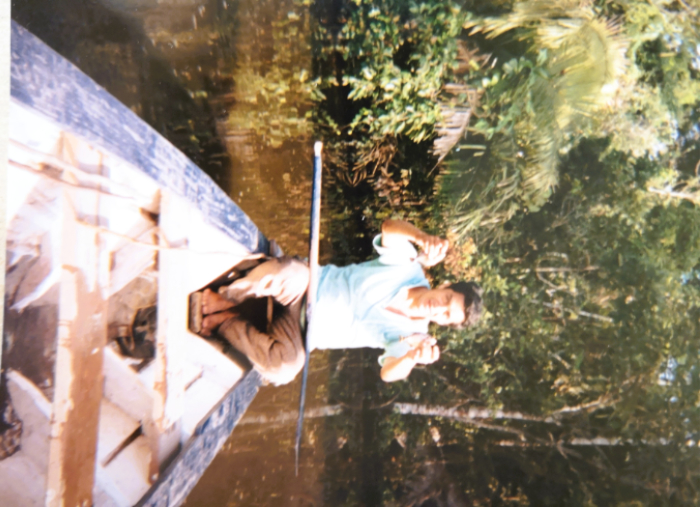
We passed giant trees and Hernand educated us. This tree is medicinal and already patented by a Swiss company, robbing Peru of benefit from its own resources. There were cures for stomachs, plastic skin from sap, Brazil nuts, cures for pregnant women, fever treatments, war paint plants, bark straps and creepers for baskets. We followed huge painted butterflies along swampy paths, landing in paradise. Cabanas of wood and palm thatch with a large lake 100 metres downhill and a cold-water spring to wash in. A slightly chastened Indiana Jones was starting to stir again. A large roof was supported by a huge dead tree with branches, creating a central communal area. We were soon on the lake in a hollowed tree canoe watching howler and capuchin monkeys, fish eagles, woodpeckers, cormorants and much more. We slid into a narrowing tributary at the side of the lake, the jungle closing in on us, past Mauritia palms and decaying old banana trees with dead papery leaves. I was in Hertzog's 'Wrath of God'. In the evening, another special moment, black caiman. Caiman are large alligator-type reptiles. Hernan could find them with a torch beam that reflects on the back of their eyes. There were more than felt comfortable, but Hernan caught two by catching them behind their heads. The larger was 1.5 metres long with a back that felt tough and spiny. A third, smaller caiman was caught by the young local boy with us. Sunset was now complete and we discovered the night sky without any light on the lake. The stars were wonderfully bright and the Milky Way densely clear in all its glory. I understood the magic of the stars to earlier civilisations. On the second day a Swiss Christian group arrived and after a long jungle walk, we found a new group of Israelis. It was becoming more touristy and at the lake we found less wildlife already. Hernand took us fishing for piranha but was upset to fail to catch one for the first time in his guiding career. The crafty piranha had taken the beef bait from the hooks without sacrificing themselves to the cause. He vowed to catch one next morning. That night I was transfixed by two saucer-sized tarantulas building a huge nest of webs on my ceiling. Sure enough, he woke us early next morning, to answer the challenge to his manhood. Things went badly until Hernand himself landed two fish and world was back in balance. We bathed at the edge of the lake and Hernand put our horror film fears to rest. "They don't attack humans, we are too big, they largely feed on dead meat and smaller prey." Nevertheless, we felt rather daring sharing the lake with killer fish.
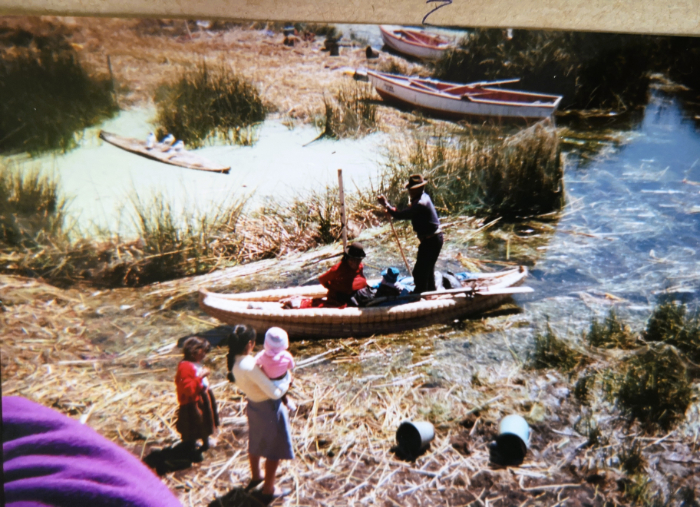
The two Germans were keen to stay for another day, but I managed to negotiate to return with the Swiss party. On the way we saw a 'Fitzcarraldo' boat decaying in the jungle, by the river. It had been part of the Bolivian rubber trade, then purchased by the Peruvian navy before ending its life as a surgery for a Spanish doctor visiting local communities. The evocative hulk had beached on a high tide and had been stripped of everything except a huge boiler and its funnel. Back in Puerto Maldonaldo, my anticipated quiet night was interrupted by the appearance of a large boisterous crowd at the end of my street. It turned out to be an election rally, a caricature of the 'South American' rally. Lucho Higaldo, 'el candidente' for Madre de Dios, was due to address the faithful. A huge stage had been constructed in the square with a giant Peruvian Flag as a backlit, backdrop and a party flag draped down the front. A band of loyalists with Lucho tee shirts, flags and stickers chanted and a big crowd gathered, awaiting the big moment. The Lucho motorcade drew up in a rusty 4-wheel drive vehicle, greeted by hand-held fireworks. The warm-up man on stage stoked the excitement with rabble-rousing invective. Lucho walked on stage and the speech began. Two hours later he finished having promised to bring transformative resources to the jungle. It concluded with an enthusiastic, excited, chanting, singing parade around the town. Backpacking Index VSO Index Main Index Juliaca-Puno-Titicaca (Uros/Tacile) The short flight to Juliaca took me to an unexciting town and the bus to Puno delivered little more than adolescents playing video games. I decided to take a boat trip the next day. I walked to the bay - wrong dock. Three kilometres round the bay and I was booked on the boat to Tacile in the middle of the world's highest Lake. The boat is the first contact with a genuinely socialist community. The Islanders met some years ago to discuss what to do about young people leaving the Island. They decided that they must embrace tourism, but on their terms. They run the only two small boats to the Island and allow only 10-15 people per boat on the Island on any day. Anyone who wished to stay on the Island was allocated a host house, no choosing. Tourist business was all co-operative and high-quality woven products receipts, along with rental and boat proceeds went into a pot divided amongst all. Equality was possible in a small, self-contained community. On the day I visited they were deciding who they would vote for in their first access to national elections. The votes would be cast according to community decision. Islanders wore distinctive, colourful dress. The men wore a tucked-in shirt with dark trousers and a wide cummerbund belt. A waistcoat was warn on top of the shirt. This time-warp, Castillian look was, I was told, a style retained from historical Southern Spain. On the same visit the boat stopped off at Uros, one of 60 floating islands, man-made by laying bundled reed on the water and laying extra layers as the lower reeds decayed. Uros was so old that it now rests on the bottom of the lake, so many layers having been laid. Some older women, men and children seemed to still live there with their reed floors, houses and boats. They have a charming museum in a 15ft shed, displays consisting of a few stuffed birds.
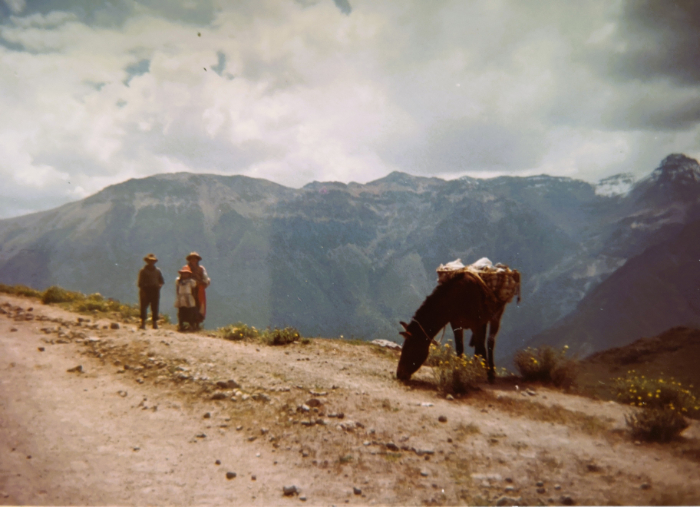
The boat had a mixture of tourists and Islanders. One U.S woman from Cusco was trying to start a craft museum and wanted to foster cross-cultural ties with indigenous mountain women. She spoke how she had visited mountain women at 5,000 ft who had never had western visitors other than the odd teacher or priest. She had written a book - Guya - but lost me when she told me she was taking a 14-year-old Cusco boy to speak at an alternative conference about how to contact alien space cultures without fear. In the evening, I had dinner with a pleasant New York sound engineer which was like entering 'Hello' magazine. He had tales of Tom Cruise, Jodi Foster, Roseanne and Cindy Crawford. He was, of course, indiscrete; Roseanne had scary multiple personalities and acted like a star, whilst Cindy Crawford was nice, but told a story of how David Letterman was weird and handed her a note in the middle of a show saying he hated himself. By the end of the meal I felt personally connected to the stars. Another one of my sub-optimal decisions. I decided to catch a bus from the airport and let all of the taxis depart. The buses came but were too packed to get on with a ruck sack. I got a short lift with an older man but had a long walk. I managed to book a ticket for a bus to Colca Canyon next day, when a lady failed to show to pay for her ticket, so time for a meal. It ended with a row about the bill which I won in broken Spanish, but they had the last laugh, I was sick all night. I got up at 3 a.m. to catch the 4 a.m. bus and was promptly sick again. I thought I would be O.K. because there nothing more to bring up. I got to the bus just in time. The bus was packed to the gunnels, the roads terrible, bumpy and full of holes which the driver to slalom back and forth. After an hour I knew I was in trouble. I got, desperate to reach the door at the front of the bus, miming my predicament as I pushed and shoved, treading on women, children and bags. I could see the fear in their eyes as they realised the danger they were in, but it was slow progress to the front. I nearly lost my glasses as I stuck my head out of the front door window, spewing up down the side of the coach. I got sympathetic looks on my way back to my seat and slept until Chivay, a small market town 40 km from the valley. The small town had a lively market with women in Christmas cake hats with colourful bands around them and men in a selection of high crowned, wide brimmed hats. They liked a hat. From Chivay we passed through a whole series of poor villages, each with run down stone or mud houses with an adobe church in the centre, some falling down. It felt like being in a spaghetti western. One village had a walled cemetery with rows of rough crosses made by tying two pieces of wood together. I was dropped at a large memorial cross, which was supposed to be the best place to view condors across the deep, rocky Canyon, the deepest in the world. I thought I was alone, but two young men came up to the cross and stopped. I thought I might have a problem and greeted them. They left quickly no problem. I sat for an hour at peace with the stunning views, but no condors, then a loud cry and a condor glided across the front of the slope and on up the canyon. After that I saw maybe ten more, one very close by.
The walk to Cabanaconde took three hours but was beautifully peaceful. I passed an older man with a younger wife and child, who looked almost Victorian in floppy hats and tattered dresses. Only a bus, a pickup and a man on horseback came past and I passed only one house with three children playing football outside. Cabanaconde was an amazing town, completely in harmony with the surroundings. There were no metalled roads and almost no vehicles. My first contact was to help an old woman chase her pigs that had run off up the street. Then a whole stream of men and women passed through with bundles of crops, sheep, goats and pigs. Old women wandered through in long bright skirts, waistcoats and a variety of headgear, including the Xmas cake hats. I reached the main square at the centre of wide roads, a central area with scrubby grass and trees being dismembered and swung upon by small children. The only traffic was a man on a lovely horse and an army truck, taking soldiers off for election duties. Two local buses left later, and children played their games of football untroubled. Small shops fringed the square, single-room buildings all stocked with the same food and pop. There were a few restaurants and 2 hotels, one of which had a T.V., the public entertainment. The market had only five stalls, but as light faded two women set up chip and salsa papa stalls making small circles of light in the lower part of the square. Electricity was intermittent. As evening chill entered the square I was wondering how I could make it through to the 1 a.m. bus. Suddenly there was a commotion at the church at the side of the square. A Jesus cargo appeared decorated with rugs and tree greenery. Several more followed and the whole village and I trekked around the town and back to the church. ld women chanted prayers, boys and priests swung incense and we stopped occasionally for readings. By 9.30 p.m. it was over, and decidedly cold. The bus was parked up and I managed to persuade the driver to let me and a woman with two children to sit on the bus until we left. Arequipa (Ciudad Blanco or Leon del Sur) It is the second largest city, situated in a valley that links the highlands to the coast. It is an industrial centre with trade links to surrounding countries. It is surrounded by volcanos and its colonial centre buildings are constructed from volcanic stone. I decided on a quiet day to recover from my queasy stomach. That was not what Arequipa had in mind. As I wandered a busy main street near the market, I was jostled a bit and took no notice. Then I stumbled slightly as I tripped and I noticed that a balding middle-aged man was again close by. As I reached the corner there was a crush of people. I instinctively pushed my way clear and looked down to see a strand of toilet roll sticking out from my shoulder bag. It had been slashed. I turned and saw the balding man. I walked up to him and said "tres tiempo" trying to convey the three assaults. He protested his innocence, turning out his trouser pockets. He turned and started to walk away quickly. 'Wait a minute you don't get away with it that easily.' I walked quickly after him. He speeded up. I speeded up. He started to run. I started to run. He turned into, what I thought was a block of apartments. I stopped, thinking it might be risky to follow. In fact, it was a cut through a shopping mall and, ironically, there was a cop standing at the end. I was happy, I had had my fun, and I didn't want a middle-aged man, trying to survive, to end up in the cells. I sewed up my bag. Back in town Jesus and Mary were still with me. Behind two cargos followed a big crowd, a band and many people, smartly dressed in suits. There was lots of incense and displays of piety. It seemed only spiritually Vegetarian restaurant before sleep, uninterrupted by panicked visits to the toilet. The plane arrived early and I had until 4 p.m. to kill time. I went to Lima's central markets and found the Spanish Colonial-style buildings much more beautiful than I expected. I reached the airport to find a situation developing. It seemed that due to a computer fault, the flight was heavily overbooked. The queue was closed and the plane departed. The angry and frustrated passengers broke ranks and besieged the ticket desk. In the middle of the melee a woman turned her head to discover that Granny, who had been left outside the besieging throng in a wheelchair, had tilted gently forward and was hanging by a thread, gazing down at the floor, resting on the footrest of her chair. Like a cartoon crowd, the whole bunch stopped complaining, went as one to Granny and tipped her upright before returning to the fray. To continue haranguing the staff. Cometh the moment, cometh the 20-year-old hero. In a wonderfully charismatic display, a young counter girl tamed the ravenous mob. In school-marm mode she told them to get back behind the rope and refused to deal with anyone until they did. They did. We eventually reached Trujillo two hours late after dark. It immediately felt stylish and more relaxed than the down at heel, frenetic Arequipa. A local hustler tried to persuade me to go to the coast, but I was battle-hardened now a chose a beautiful Colonial-style hotel with an interior courtyard next to a cobbled plaza. I had messed up the air ticket dates and gave a helpful English-speaking woman a difficult morning as I bullied, blagged and smoothed my way to a renewed set of date that would get to Ayacucho in time for Easter Saturday. The downside the sacrifice of my day in Trujillo. I had to pack in a lot of sight-seeing, in rapid time, the colonial house, Chan Chan, the largest adobe city in the ancient world, pre Colombian home of the Moche and Chimu, pre Inca, cultures, Huaranca, a touristy surfing village with reed boats and a rapid trip back to the airport. I had earnt my tourist achievement certificate. The late-night flight back to Lima resulted in a nervous walk to a cheap hotel in a risky part of Lima, but no problems. Ayacucho had been a dangerous highland Andean town for many years because of the activities of the Shining Path, a violent Marxist group, spawned in the town and ruling the area for 14 years. April had told me of a small-town mayor close to some land she owned who had an explosive belt attached to him which was exploded in front of his people. This year was the first that the Ayacucho Easter celebrations had been open to the outside because of the improved security situation. I tried for a 'Lista d'Espero' by getting to the airport early and after an hour got a flight. As I arrived tired at the airport in Ayacucho, I was approached by a young woman, asking if I had rooms. Luckily, I got through my tired, tetchiness and found myself at her house with her very nice, mother, gran, and brother. I took it slowly, washed clothes and myself and found out at the there were no available flights out for seven days. I put it to one side and met an O.S.S. man, there to monitor elections, who told me that there was an event this very evening. The brother gave me lift into town. I was greeted by a totally unexpected sight. From the church, on the roads all-round the square, teams of people were busy making 20 x 20 feet artworks of coloured sands and flower petals depicting religious and liberation themes in exquisite subtle tones. Two people stood embracing each other in tears. At 9.30 pm. two giant cargos emerged from the church, impossibly carried on the shoulders of teams of men. Jesus was preceded by the top brass, men from the military, police and civic dignitaries. Mary was followed by the women. They walked over the artworks, stopping at each corner of the square where beautiful singing by choirs took place and a brass band played all of the way round. The moving and emotional procession ended back at the church. This left the square to the performers; an indigenous man gave a one-and-a-half-hour street performance of what appeared to be a humorous play and some tiny mountain people emerged. A blind man of no more than four feet in height was led by two young boys, about 8 and 10, and nearly his height, from group to group where he played his fiddle, badly, for coins. Two small mountain boys in Peruvian ear-flap hats played simple melodies on curled ram's horns. The balconies on the houses all-round the square remained full of spectators. What a start to Easter. At breakfast, next day, I spent an enjoyable, relaxed time with the family and a lawyer from Lima who spoke English. We walked into town and there seemed to be an air of excitement building. Quite suddenly, a group of about twenty-five horsemen trotted into the square. They were a mixture of mountain men and others with classier ponchos and sombreros on high stepping ponies and horses. They rode back and forth, to the applause of the crowd, raising their sombreros to the people on the balconies. The horsemen rode out of the square only to appear within minutes to the gasps of the crowd as people saw that a fighting bull had entered the square held only by two ropes tethered to two horses. The bull was led round the square charging at members of the crowd. There followed, at intervals a single loose bull that made us scurry for cover, a young man climbed up a lamppost. A beautiful black and white one came in tethered to horsemen. It was all scary and fun, but one woman was gored on the arm and local men tried to look brave running out behind the bull. Phew! During the afternoon, the cargo for the Easter procession was under construction by a team of helpers in the cathedral. Long tree trunks formed the base and the structure tapered up in pyramid form to Jesus at the peak. All was covered in white plastic flowers, shapes and hundreds of candles. At regular intervals rockets were set off with frightening acceleration and even more frightening percussive bangs. Indigenous women ran food stalls and sold their wares. I saw a concert advertised, for this evening, on a tattered poster. I was curious and eventually found the municipal theatre. As I waited for a ticket, a tall thin man of about 25 years, looking dishevelled and undistinguished with a guitar had difficulty getting the security to let him in. When I entered the theatre, I found a dingy brown and blue auditorium with rain-damaged ceiling tiles hanging down. The seating was basic and hard. The small stage was bare with functional lighting and the village hall effect was heightened by the fact that the only way to reach it was through the auditorium and up through the wings, which had curtains that did not reach the floor, allowing the audience to follow the progress of several pairs of legs across the edge of the stage. From this unlikely setting, emerged the most wonderful concert. First on was Señor Fuentes, a small man in a suit who quickly donned a poncho to curry favour. He performed distinctive songs, punctuated by flamenco foot-stamping breaks, accompanied by a guitar and, later, a local box harp. Then it was the turn of Mansquelcha, a squat, tubby man, with shoulder length hair and a beard. He came to the front of the stage in his poncho, raised his arms to the chattering audience, and gave a diva's bow. His playing and singing were great. The audience often clapped the sentiments and shouted comments. He received an enthusiastic ovation. After an interval, Mansquelcha was followed by a middle-aged harmony duo and the dishevelled man from the entrance, who turned out to be quite good. It had been a three-hour show and I was delighted I had gone. Back into life in the square, the night was in full flow. Bands were playing all around the square, two marching brass bands, an up-tempo electric band in front of the Cathedral and an acoustic group in the centre. All around it was 'punk party night' as circles formed, people ran and jumped around, bumping into each other, leaving many sweating and panting at the end of numbers. Occasionally, a marching band would start off round the square, people, led by a couple holding beer bottles aloft, formed rows, linking arms and swayed from side to side of the road. Alcohol was flowing, but there was only good humour. It lasted until 12.30 a.m. and as People started to drift and I got into conversation with a young man. He and his friends persuaded me to go with them to a pena, where a Bolivian band was playing. I was quickly trying to dance the local two-step hop from foot to foot with a variety of 40 something women and great fun was made of me by the compare on the stage. A lovely 35-40-year-old woman was persuaded to get up on stage to sing. She had a black hat with pom-poms and a black dress and coat, with a blanket draped over her shoulder. She sang, melancholic, sentimental ballads to great effect and approval. Eventually, At around 3.30 a.m. the inebriated crowd pushed out of the pena and staggered back to the, still, crowded square. We pushed our way through and stood close to two 40ft bamboo towers. At 4 p.m. a man stepped forward to light the first firework of a scintillating and artistic display. From the first firework, each set off the next in the chain or split into two spinning, sparkling or exploding effects. No fancy electronics here, just pure skill and ingenuity. On up the towers, Catherine wheels spun, sparkling strings of rope glowed red and green, lanterns lit up and artificial birds spun as they circled the tower and showered the square with glitter. Then, a gasp, as a model plane flew straight towards the heads of the crowd, stopping just in front of them. We realised, at last, that it had on a wire. The display climaxed with a 'Close Encounters' spinning spacecraft rising into the sky and exploding in a shower of sparks. By this time bonfires had been lit around the square, signifying hell. Jesus emerged from the Cathedral, glowing in the light of hundreds of candles and carried by, I was told, 300 men. He was carried gently to the square, preparing for resurrection. As he progressed around the square, 8 towers of bangers, ear-shatteringly loud, greeted him. Having overcome the devil Jesus returned to the Cathedral. Stunned, I said farewell to my chums who I had shared such fun with, in the few phrases of Quechua they had taught me. They hoped I would keep Ayacucho in my heart. The light was strong as I left for the airport early, later in the morning. I eventually, caught a bus, passing a man dead on the street. Sadly, no resurrection this time. I got to the airport, concerned by the warnings of no seats for several days. I was already down at number 17 on the list for 'Lista d'Espera'. A long, tedious wait concluded with the first plane leaving with no spare seats. Still at 17 in the queue. The second plane was delayed and only a few hopefuls found seats. As, on the outward flight, tempers started to fray. Order began to break down and the manager, unused to the pressure, wilted and barricaded himself and his staff in the office behind the counter. It did no good as customers, roaming like feral dogs, forced the door open and pushed into the office. There was just one more plane, everyone was under pressure. People started to get places on the plane, and I managed to join the scrum, pleading the need to link with the Pucallpa plane next day. He put me to the top of the list, and I joined the Lima lawyer on the flight back to the capital. We landed late and I had another nervous walk to a cheap, noisy hotel. Backpacking Index VSO Index Main Index There was no rush to get to the airport, so a good breakfast and silly diversions, left me late for the plane. I was then stopped by the police on the way, taking more time. I arrived at the airport, sweaty, puffing and agitated, made worse by finding myself in the queue behind a fat man with a large family, luggage, bikes, bowls of fruit etc. My luck was still holding; the plane was delayed by 30 minutes. I found Pucallpa an ugly place of concrete buildings in the sweltering Eastern heat, so I took a bus to Yarinacocha, a small, lakeside, fishing village 5km away on the outskirts. I decided to try to book a boat trip before committing to a hotel. The waterfront was dirty and busy, and I was quickly a target. I took a dislike to the first man, then found a nice guy at his house but he wanted too much. I returned to the waterfront, disheartened. There were no tourists in town to share with. A quiet young man approached me and suggested he could do the trip more cheaply, so we went back to his place on a bicycle-rickshaw. His place was a large wooden shed with a leaf-thatch roof. There was a mud floor with a raised section at one end for 4 beds to serve 3 children, Alfredo his wife and her brother. Alfredo's house was set in a wide rutted dirt street with similar huts either side of the road. There was no electricity, although someone had put in street lights just in case it arrived. We agreed the price and Alfredo said that I could stay the night to save money. This was on the drug smuggling route through Amazonia. Just eight days previously, several people had been killed in a shootout, and only two days ago some had their homes fire-bombed. When I told her April had her own story of a friend, forced to flee his long-owned hotel by the Shining Path. It was also burned down. Next day, the boat loaded, a second man joined Alfredo and me, and we set off across the Yarinacocha oxbow lake. There was little see and the shorelines of the lake were busy and cultivated. The scenery improved as we entered a narrow channel to the Ucayali River. There were iguanas, freshwater dolphin, and varieties of birds and fish. The men were frustrated at me as they pointed out an Iguana in a tree, who's camouflage completed worked on me. By mid-afternoon the Amazon heat was proving too much to go further. I slept, while the boys fished for piranhas. As the evening cooled a little, we pulled into the shore next to a single thatched hut stood on a raised platform above the riverbank. The hut was open, with no walls, on one bed lay a sick mother. A pleasant-looking father, a 10- and 12-year-old boy and girl and an adopted girl of 15 years made up the rest of the family. The adopted girl's parents had both died. They lived self-sufficiently by fishing and growing plants around their house. We later saw that there was one other house about 100 metres upstream. I played football, joyfully, in the mud with the children, but witnessed the disturbance in the older girl's emotions as she put a noose around a cat's neck and hung it on a branch to watch it desperately try to claw its way up the string. She released it after a while. That night we went out in the river to see largos (small crocs) and caught several. We glided next to one, lying motionless in the river. As we came alongside it the boat owner lifted his machete and, with one blow, almost severed its head. In the early light next day, we cast a net around a floating island of weed and, as we returned, pulled the net tight catching a huge variety of fish, some half eaten by piranha, and one catfish that croaked. Our food was almost entirely fish soup and rock-hard plantain. At night, we slept on the floor under mosquito nets that trapped as many inside as it kept out. I was badly bitten, probably the mother had malaria. On the final day I was keen to see the local Shapibo people's villages, but it seemed that the boys just wanted to get home. As we came to a channel were buzzed by a local drugs boat, a fast cabin cruiser, which we had seen the day before on its way to the Brazilian border. It contained 4 young men in U.S. style caps on backwards, who cut across us to create a bow wave. I sat as quietly as I could. When we eventually reached a mooring place which led to a Shapibo village, Alfredo, said that the path was too flooded to walk. I insisted that we try as the first part was completely dry. He was right, of course, as we ended up wading in muddy water up to our knees, coming across, what we thought was a boa constrictor, but turned out to be a dead electric eel, the thickness of a leg. Alfredo was scared that there would be boas in the area and we turned back. It transpired that there was another passable path, I should have trusted Alfredo by now. We spent a hot two hours tramping paths and getting lost before finding the villages. The first village was home to straight, black-haired people in matrilineal society, engaged in pottery and bow and arrow making, geared to tourism. The second village was suburbia in the jungle. Rows of neatly spaced thatched huts with road names, shrub and flower hedges and a large area of cultivation. We went back to the boat, and the boys got their wish to go home. I spent the night with Alfredo. Alfredo offered to come to the airport, but I had time to look around Pucallpa in case I had misjudged it. I hadn't and was pleased with my uneventful flight back to Lima. I had time for one last trip to Huanca, a Quechua-speaking valley in central Peru. I booked a bus ticket for later that day. I left my rucksack with the bus company and went off in relaxed mood to find food. After a snack, I walked back towards the coach station. A well-dressed middle-aged woman approached and pointed at my back with a pained expression on her face. I thought it was shit and stopped by a food stall to deal with it. She handed me some tissues from her bag. I peeled my tee-shirt off, putting my shoulder bag on the floor next to my leg. I looked up and she had disappeared, along with bag, containing traveller's cheques, tropical beads and a stuffed piranha. "Mi balsa" I whined The two people behind the stall simply pointed along the street, having watched the whole sting with dumb interest. The irony was that I had read about this very sting only to be lulled by the well-dressed woman and my own demob-happy complacency. You always play the major part in conning yourself. I realised that I had to get a police report for insurance. I gave up on my trip to Huanca, collected my rucksack, and settled for a local police station instead. The detective couldn't have been more friendly and helpful. We tried to negotiate the language barrier, me with fractured Spanish, him with slightly less-fractured Spanish. "Country?" "England", his arms went up in the air, "Ah Bobby Charlton!" he beamed (the famous footballer), he went on to eulogise, English Blue-eyed women, John Lennon and Kevin Keegan We went along fairly smoothly noting the contents of the bag until I reached the stuffed piranha on a stand. "Pescado?" I said, inadequately searching for words "Pescado?" he replied, wondering why I had fish in my bag. At last, with the admin complete, he asked where I would stay now it was dark. I searched my guidebook for a cheap hotel nearby. I showed him. He wanted to know how I would get there. I told him I would walk, he was horrified. He indicated for me to wait in the front of the station. As I waited, it was time for the new shift to start work. A scene from a bad B movie unfolded in front of me. A dozen uniformed policemen slouched in and lounged lazily, on or against anything at hand. An officer briefed them as they looked insolently at their boots or the wall ahead. At last, they dragged themselves, painfully, to their feet and disbursed. Two approached me and signalled me to follow. We went to a police car, and he indicated that I should put my rucksack on the back seat. I threw it carelessly in and he pointed disconsolately; I had thrown my bag on top of his peaked cap. They got lost on the way to the hotel and dropped me at another hotel for a peaceful night. I spent a couple of days with April to enjoy her wonderful hospitality, recuperate and swap tales. I was able to join the areas annual festival with salsa, fireworks and a surfing competition, before leaving this wonderful country with everything, jungles, mountains, deserts, lakes, history and generous, enjoyable people.
|
||
Paul Hague explains. Backpacking Index VSO Index Main Index ***************************
|
||