A Trip to Congo 1995 |
||
The Honorary Consul had a small London office, and this older French man was delighted to receive interest from someone wanting to visit his country. He wrote me an introductory letter, stamped my visa and told me that I would have a wonderful time in his country.
Journey Into the Unknown The flight had been delayed, and I was becoming increasingly nervous at landing in an unknown country after dark without any local currency. As we entered the last hour of the flight, I decided that I needed advice and looked around the plane for a possible source. I chose a man, in his late 40s, I would guess, who dressed in a sensible sports jacket and trousers and with conventional short curly hair looked as though he might be on a business trip. "Excuse me, I was wondering if you have any knowledge of Brazzaville as I have no local currency and am not sure what I can do when we land." It turned out that he was a friendly, approachable English man who ran a second-hand clothes business across four African countries. "There won't be any currency available at the airport at this time but I am going to an hotel in Brazzaville, and I can ask them to change some money for you. Go through customs and I will meet you on the other side." "Do you have a visa already?" I asked and he half smiled. "I never bother with visas, I give them $20 at the gate and they are happy." Relieved, I thanked him, told him I was pleased to have found him and returned to my seat to enjoy the last minutes of the flight.
It took some time to get through customs but sure enough there was my new friend waiting. There had been no problems with the visa, and they were pleased to see him again. "You can come with me in my taxi and if you want to you can stay at my hotel." We entered a big Peugot Estate, and we chatted as we took the long drive from the airport into Brazzaville. As we went, I asked him about his business. "Last time I was here I had a bit of trouble. I had a local partner, and he stole my briefcase with money in it. I made a complaint to the police and gave them something for their trouble. The next day the police turned up and arrested me. He had given them them more money than me, so I was put in the cells." As we came into Brazzaville streetlights appeared and he casually pointed to a line of trees, "During the coup a few years ago, they hanged people from those trees." I was becoming a little less confident of my choice to come to Congo. At the hotel, as he had told me, they were happy to change money for me. "Do you want me to ask them for a room?" The prices were fairly high. "It is a bit too expensive for me are there any local guest houses nearby?" Hotel reception directed me one about 300 metres away, we shook hands, I thanked him and we said our farewells. I didn't see him again. It was a perfect start. A Graham Green character, a traveller's brief but florid contact and stories to tell already. I left the hotel at around 10 p.m. and headed down the deserted street towards the cheap guest house keeping my eyes peeled for any signs of threat in this new and unknown place. Luckily there was a room which turned out to be basic but comfortable and, most importantly, had a working lock with a key. I relaxed and got ready to sleep. Before I had settled there was a loud knocking on the door. I ignored it. The knocking continued. I went to the door and in my best schoolboy French asked who was there. There were two young women offering room services with mime and sound effects to ensure that I understood what was on offer. It took some time to persuade them that I wasn't a customer. I then managed a good night's sleep, already looking forward to making a start in Brazzaville.
I had read that Brazzaville was manageable as long as you did not venture beyond a certain street into the less salubrious neighbourhoods. I set out to explore. I saw the cataracts (rapids) on the Congo with Kinshasa on the opposite shore and as I wandered, I came upon a cultural office that looked as it might be a good source of information. There were some young French people who were only too happy to chat. When I asked what I should look for in the country they told me of a European Union Project across six central African countries to preserve forests and conserve wildlife. You could book for a week's stay. I booked during the last two weeks of my stay and left with a growing sense of well-being. I eventually found my way through crowded streets to the area of grand colonial official and government buildings. I saw a mansion which was the state residence. I crossed the wide boulevard to look at the house. Aware of movement to my right I turned to see two policemen approaching. They wanted to know what I was doing. I explained as best as I could that I was a tourist and just looking. They asked if I had a camera. In those days I took disposable cameras which were a flimsy case with a fixed plastic lens that contained a film. The film was processed back in UK and the camera was reused. I showed it to the policemen and said it had not been used. Disappointed that they had not found a fancy camera worth a fair bit they said that they had to take the camera to check if it had been used and that I should come to the police station to collect it tomorrow. No chance. I knew there would be a sting. So, one of my two cameras had gone. As I wandered downhill along a long busy street, I found my way blocked by two young men of late teens. The braver of the two challenged me to dance with him on the pavement in an attempt to embarrass me. He was surprised and amused that I joined him in a brief dance and we parted delighted friends. By now it was mid-afternoon and I had had enough excitement for the first day. I walked slowly back to the guest house. As I reached the entrance there was a young disabled man in a wheelchair at the side of the path. I greeted him and we exchanged some friendly words. He was a small man with very wasted legs. I said farewell and went to open the door to my room. As it opened, I was aware of a blur of movement. He had launched himself out of his wheelchair and scuttled across the floor at super speed ending up sitting on the cabinet next to the bed. It turned out that he spoke some English and we chatted for a while. He told me that he knew Brazzaville very well and we agreed to meet in the morning. He leapt from the cabinet, scuttled back to his wheelchair and wheeled off down the road. I settled down to read my Lonely Planet Guide. I always worked on the principle that I should get out of the busy capital as quickly as possible only to return when I was better attuned to the country and culture. That was the best way to avoid trouble. Only.... the L.P. Guide had an opportunity that was too good to miss. There was a weekly gathering at an American ex-pat club that was a must if you were in Brazzaville. It was a way across town with no transport running and after dark. Oh well just too bad.
By 6.30 p.m. my frustration had grown. It said that the U.S. club was a must do in Brazzaville. I had to go. At 7 pm I left the guest house, map in hand, in trepidation. As on the night before the streets were deserted and for once I was pleased not to see anyone around. The boulevards were wide empty streets with tall houses on either side and eerily empty of any sign of human life. I walked for 15 minutes, still uneasy but focussed on the map as my comfort blanket. I passed a small row of shops and crossed to the opposite side of the road. From the darkness of a concealed entrance came a base note. "Hey," I ignored it and started to quicken my stride. "Hey," this time the sound was louder, more urgent and threatening. The only thing was to turn and face the challenge. I entered the gloom and there was a large man in soldier's fatigues sitting on an old chair surrounded by four other soldiers all armed with rifles. "Papiers," he said with no attempt at pleasantries or introductions. I silently handed over my passport and introductory letters. He went through them with mock formality and then we conducted a conversation in my broken French with diplomatic interjections of "Je ne comprends Pas" when I didn't want to or could not understand. The conversation started with him telling me that my papers were not in order. I protested that I knew they were. He upped the ante. "You will come with us to a police station" "OK that's fine but I will want to call the British Ambassador." He soon got to the point after that. "How much money have you got." "A few coins" "Where are you staying?" "At a guest house in Town" "One of my men will come to the hotel with you and you will give him some money" I shook my head. " I don't want to do that lets go to the police station and I will call the UK Ambassador" At this point he decided that it was all too much trouble. He signalled me to approach him. He put his hand into my back pocket and scooped out about £2 worth of small notes. His colleagues were still impassive. He waved me away with a disdainful sneer. I walked away unsure whether to proceed or go back. My adrenaline influenced decision was that I was not going to miss my night out. The night at the US High Commission turned out to be a bar room with a variety of ex-pats in a cheery but calm atmosphere. I spent most of the couple of hours there in pleasant but unremarkable conversation with a couple of men at the bar who were not particularly impressed by my tale and agreed that I had got away lightly. I finished the evening slightly disappointed by the 'must not miss experience' and aware that I had to retrace my steps given no offer of a lift home. The walk home was again along empty boulevards. I kept a brisk pace until I reached the soldier's lair. I nervously glanced across the road half expecting them to call me over again. Thankfully, they were no longer there, and I progressed serenely back to my guest house room where the key was firmly turned. They ladies had not bothered tonight and I managed to sleep.
Sure enough, Davide was at my door bright and early, excited to take me around Brazzaville. I don't remember where we went or what we did but the abiding memory was the huge smile on Davide's face and the great enjoyment he found in greeting his many friends with a sense of superiority as he was pushed along the streets by a colonial representative. We parted the best of short-lived friends; both having enjoyed a fun day.
A Bus Ride to the Brazzaville Bus Station Brazzaville Congo is a long thin country, and I had decided that I would travel by bus gradually to the north where the conservation area was situated. The advice was to get to the bus before 6 a.m and as with all bus stations it was at the edge of town. The linking town minibus could be stopped about 10 minutes from my guest house but there was no marked stop. Once again, I found myself on the streets in the dark with no one around at about 5.15 a.m. This time I had a backpack and found myself in an area of much narrower streets in an obviously low-income area. A few people began to walk past but no minibus was to be seen. I waited nervously. After some time an old, battered vehicle appeared and I waived it down. The rule on transport is that the fills up from the back, so I went to the rear, and my pack was wedged just behind the front seats. I was worried that it could be grabbed from the door and I could not do anything to stop it from my seat. As we travelled through unknown areas of Brazzaville the first signs of dawn started to emerge and as we reached the bus station, I was able to see a desolate, scrap-filled site with only a couple of coaches in sight. I breathed a sigh of relief that my bag had survived and that the first trip across town had been uneventful. The minibus stopped and the side door slid open allowing the passengers to disembark. Before I could get to it my ruck sack had been grabbed and disappeared out of the door. By the time I could get out a thin, wiry young man had my bag by his legs. He pointed to his coach, an ancient looking vehicle with faded blue trim. "Le Lac Blue?" I asked. He enthusiastically agreed. Before anything else could be said another, a better dressed, young man appeared and took hold of the ruck sack. Shouting started as they both vigorously tugged at my rucksack. Although it was strong I was worried that they would tear it apart. I joined in the melee and took back the bag. Only I could resolve this situation. I did not like the aggressive way the second man had tried to muscle in so I told him that I would go with the first man in his old bus. He was angry and uttered a few expletives as he marched off to his, admittedly, newer and more serviceable bus. I entered the old bus and looking across at the more desirable vehicle began to doubt if I had taken the right decision. This feeling became stronger as it became obvious that the other bus was filling much faster than mine, but I had given my word. Eventually, the other was full and it left with my bus only half full. The well-dressed man hung out of the bus door gesturing to me in gloating triumph as his bus drove off. I waited nearly an hour before we were ready to go and thus began my first gently paced journey in Congo.
It wasn't a long journey, and I was put down mid-morning on a dirt road with only a few scattered houses nearby. As the bus drove off in a cloud of dust I began to take stock. There was no sign of a guest house, so I began to think about hanging my travel hammock between two scrubby trees at the edge of the small lake. Three teenage boys had watched me arrive and came over talk. One had good English. Following some introductions he said "Where will you stay?" "Oh, I have a hammock, I will sleep down by the lake." He grimaced. "You can't sleep there the mosquitoes will eat you". He came up with an idea. "There are some white people near here, we will take you to them and you can stay there." I checked that it was not too much trouble and we band of brothers walked off happily into the bush. As we walked, I asked them about their lives and the white people we were to visit. They often saw the white people who were their friends. We walked across low undulating hills in wispy grass lands. The sun grew hot towards mid-day making my brow grow sweaty and my bag grow heavier. It became clear that their idea and mine of what was 'close by' lacked congruence. At last, as my water supply ran dry, we came in site of a sizeable house next to a small river. As we arrived a young man appeared at the door of the house, who I recognised as one of the young French people from the bureau in Brazzaville. The boys greeted him cheerily; he had a clouded face. "What are you doing? We told you not to bring visitors here.". The boys looked crestfallen and I realised that this was not a place to stay for the night. As he realised that I was not about to cause trouble he softened and agreed to my request for a drink and rest before we set off on the long walk back to the lake. We spent a cheery time chatting about the fun weekend they were about spend at the hideaway, tractor tube rafting on the river, but at no point was there any offer of further hospitality, so after a while we started the long trek back to the lake and the road in the late afternoon sun. By the time we reached the road again the boys had recognised my exhaustion and helped me to carry the bag. As we reached their small hamlet I asked if there was any accommodation locally. One boy asked me to sit for a while, and he disappeared into a local house. He came back smiling. My father says you can stay for the night. The day ended in a lovely evening with an African family Backpacking Index VSO Index Main Index Off to Owando and on to Odzala National Park I arrived at my next staging point, Owando, as dawn was breaking. The light was silver and the night chill nipped at my body as the first sun's rays warmed my skin. I walked to the centre of the small town where I was stopped in my tracks by one of those rare magical touring experiences. From the large Catholic church across the deserted square wafted a beautiful soprano choral mass in French. I sat down on a step and let the waves of ethereal sounds wash over me. I found myself both tearful and calmed. At the end of the service, I breathed a deep sigh of contentment and began to gather my belongings. Before I could move drums had started in the church which marked the sound of African mass coming from an earthy vibrating source that energised rather than soothed. By the end I felt blessed by the moment of of spiritual emersion in the solitary quiet of an African town mostly made from mud in the middle of Africa, far from home. I rose from my step feeling completely at peace with the world and started off to look for somewhere to stay. As I reached the river bridge people were beginning the round of daily tasks as life cranked up the engine of day. I heard a voice behind me and turned to find a strongly built man in his mid-thirties talking to me in French. He asked where I was going. "Have you registered at the Police station?" His tone was authoritative and slightly threatening. I apologised that I did not know that I had to register and with his status recognised he began to thaw. He showed me a local guest house and waited for me to drop my bags. Outside he told me that there was a local handball (a fast team game like football but with the ball being thrown and caught by hand). We walked to the local field where a game was in progress. Athletic young men ran, shouted, argued and celebrated as the ball flew into the goal. At the end of the match my now friendly policeman excused himself as he was the referee of the next match on an adjoining pitch. I watched the match from a distance. It was an ill-tempered affair that blew up into a heated dispute between my policeman friend, the referee, and an aggrieved player. From a distance I became aware of how much the pair looked like a pair of barking dogs. First, they came close to each other barking, looking as though blood must be shed, then my policeman turned his back and walked a few steps but turned back and barked again before walking back towards me. By the time he reached me he was back in good humour, and we greeted before separating to go our separate ways. The next day was the day of the local dance festival of the year marking a public holiday. It seemed that local groups came together in their neighbourhood to dance together close to their homes.
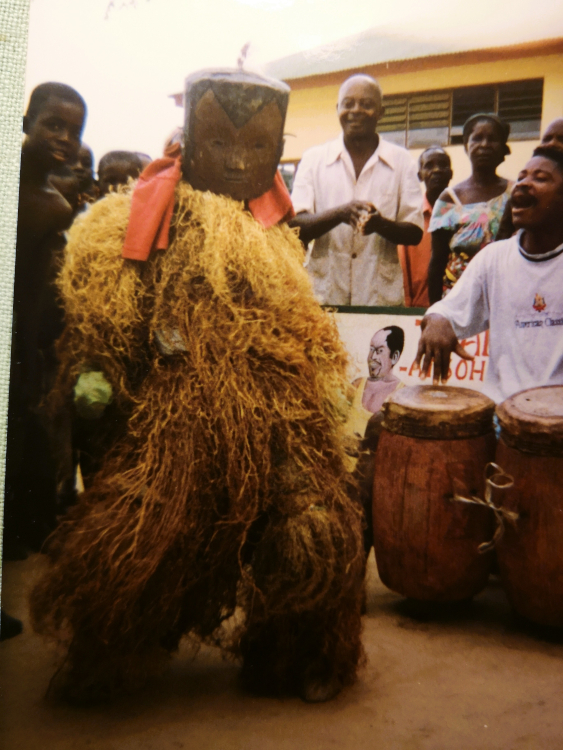
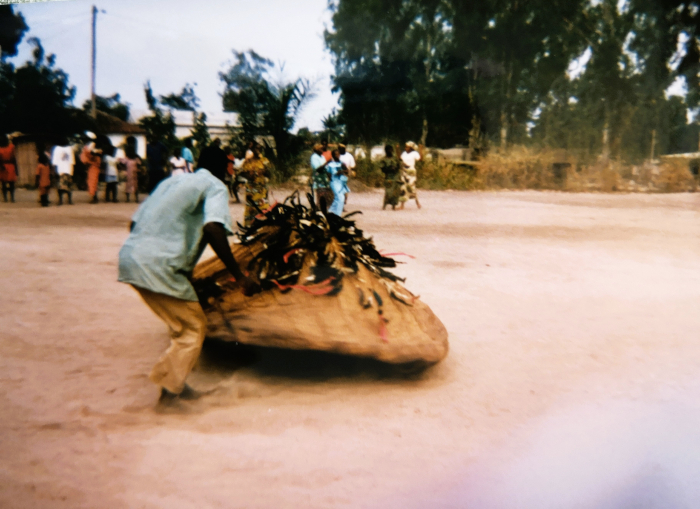
As I wandered from area-to-area, wondrous spectacles unfolded. Here a group of masked dancers, there a swirling tossing monster of long grass completely obscuring the human within.
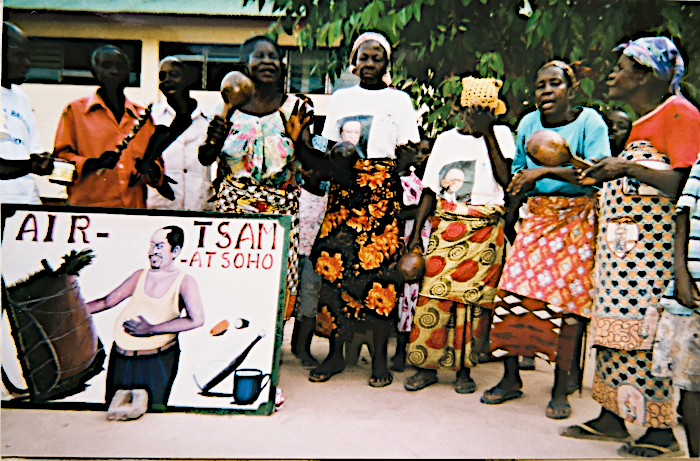
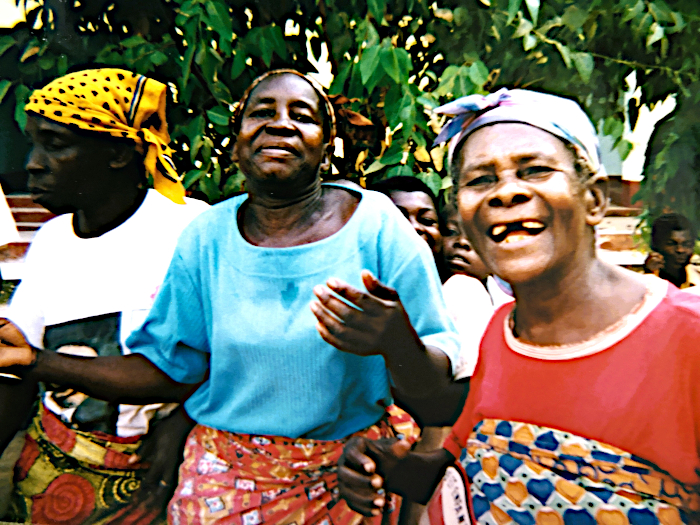
The monster spun vigorously, sending grass in waves of movement mirroring the motion and chasing the human dancers around the arena. At last, on the edge of the area, I came across a group of six or seven older women, all of whom must have been in their seventies and eighties. On seeing me they lined up and clapping and singing in their headscarves and long dust smeared skirts dancing in a row blocking my path. I stopped and clapped in time with their dancing.
One stepped towards and began her sensual and provocative dance towards me.
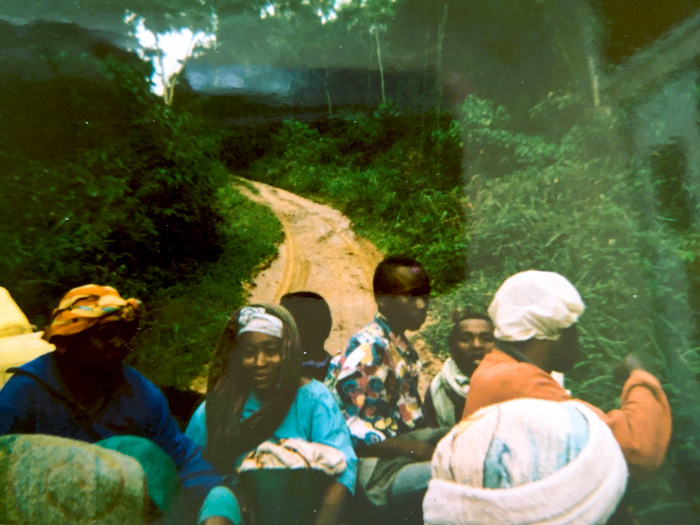
I joined in with her dance until with a gap-toothed grin she gave in to exhaustion. I pressed the traditional cash note to her forehead, and we all parted happy and laughing at the encounter. Owando had yielded up its rural town treasures. The next day was time to move on. There was no bus heading north, so I decided that the square through which the only main dust road passed was the place to wait for vehicles which surely must pass through. I rose early and waited patiently in the morning sun as it moved slowly across the sky with no sign of vehicle movement. As I tired, I went to sit with my back against a tree, beginning to think that I would be here another night. I was almost unaware of a smart four by four Toyota that pulled up next to me. The window slid down and a pleasant looking middle aged Italian catholic cleric greeted me. He asked me where I was going in fluent English. When I told him that I was heading North towards Odzala National Park. His face lit up and he turned to talk to his passengers. "My visitors would like to see the park. Get in and we will collect our things from my home. We won't take long." Owanda just kept delivering. The Priest was charm itself and I settled into the back seat next to two of the four occupants of the Toyota Land Cruiser. We cruised along for more than an hour, the conversation pleasant, the ride comfortable and air conditioned. My only concern was that I would arrive earlier than my booking date. As we passed a rural village in the midst of forests the Priest raised a concern. "The oil light is flashing!". He stopped the car and got out. When he came back the news was not good. "The plug on the oil sump has gone. They must have failed to tighten it at the service." He quickly decided that the trip was over and help would be summoned to get them back to Owanda. My thoughts turned quickly to the options. Would it be better to go back with them, or should I try to stay at the village in the hope that transport would arrive? I stood by a wooden bridge by the river. The priest had gone into problem solving mode and had little time left for my predicament. At that moment a huge open backed truck came along the road went across the bridge and stopped. People and goods descended. The Priest looked at me and pointed. "Quickly, get your bags and catch the truck." In a confused state I grabbed the bags, shouted back my thanks, and ran across the bridge to the truck, hoping it would not drive off before I reached it. A tall youth in a pink plastic shower cap gruffly told me the price and indicated me to climb up into the open back of the truck. It was full but not crowded and I settled next to the cab to enjoy the trip.
The young man came around to collect fares. He had jumped from the truck at a brief stop and raucously shared some local hooch with companions before getting back onto the truck. He was now drunk and his gruffness turned to roughness as he ordered people older than him about in a threatening way. He took my fare without care, in a surly manner, but did not engage beyond that. People were acquiescent, they would not risk being put down in the middle of nowhere. The boy continued to harangue people looking vaguely comic in my eyes in his lopsided plastic shower cap. As we progressed along the narrow track road it became increasingly rutted. I wondered how the priest's car would have managed and sure enough we saw a land rover struggling to make progress as the mud came up to its axel in places. As we passed an avenue of full-grown trees a shower of gaudy caterpillars descended on our heads and clear areas of the floor. I was concerned that some caterpillars are poisonous and quickly brushed them from my person and the area around me. We were heading well into afternoon now and progress was slow and bumpy with little sign of human habitation. At last signs of life began to appear and we eventually stopped in a collection of low buildings close to a river. It was not big enough to call a town but was obviously some kind of functional meeting and trading place. I realised that regular public transport was unlikely and took stock of what options were available. On this luckiest of all trips my luck held out. I approached a land rover to ask if they knew how to reach the National Park. "We are from the park; you can come with us." The rough track took us past a herd of buffalo, which the driver assured me were some of the most dangerous of animals. Huge beasts with short tempers and stout horns welded to their enormous heads. Within 30 minutes I was in the forest at a planned collection of low wooden huts, with one larger two-story house at the side. The whole area was surrounded by tall dense dark green forest. The staff member went inside to tell the manager I was here. The manager, a tall pleasant French man in his late 30s, looked at me with a pained expression. "You are not booked until two days' time and our current group do not leave until then." "Can you suggest anywhere that I could stay in the meantime?" "Oh, look you can stay with me and my wife for two days until you start." The family turned out to be delightful, feeding me and welcoming the chance to chat to someone not caught up in the daily pressures of dealing with local disputes and culture clashes. It turned out that this was one of six eco-tourism conservation projects stretching across Central Africa supported by the E.U. As we discussed the problems he faced in dealing with the local workforce I began to get a sense of the project. The huts had been used in the past as hunting camp and local people had been part of the decline of wildlife in the area. The project had literally persuaded them to turn from being poachers into gamekeepers. They had been sold the idea that there was more money in tourism than meat (the name given to animals was the same as meat). There was a regulation that no more than six tourists could be in the park at any time to avoid compromising the local people and the ecology. As we sat around the table the stories began to emerge. The diners were the manager, his wife, a local wildlife researcher and me. We started at the hunting history of the camp. "The hunter who ran the camp was a South African hunter with a taste for drink. Once, he had a rich Belgian tourist who wanted to shoot for trophies. The hunter and the tourist decided to spend a night in a tree shelter which would provide a good early morning vantage point over the clearing below. The half-butchered carcass of a buffalo had been left at the foot of the tree by the indolent hunter. They climbed the wooden ladder up to the shelter and the nervous tourist worried about their safety. The inebriated hunter brushed aside any concerns and settled to sleep. The Belgian was not pacified and sat upright listening to every sound. In the early hours of the morning a scuffling sound set the Belgian on edge and he peered across the floor towards the ladder. A large paw appeared at the top of the ladder followed by the head of a huge female lion. He screamed; the hunter jumped up and grabbed his rifle. As the lion came onto the platform he shot and it fell back, falling to the foot of the tree. It was not usual for lions to come into the forest; they were creatures of the open veld. "She must have very hungry to venture here. Let's go down and check that she is dead." They both reached the ground and were examining the dead female when a loud roar filled the air and a second lion emerged from the far side of the clearing charging at them. The hunter kept his nerve and shot the second lion dead just before it reached them." I was impressed and somewhat slack-jawed at this tale of my new home. We really were in the jungle. The researcher was not to be outdone, however, and told me that she had an even more astounding tale of the forest. "We had been away for about a week upstream and when we paddled back into the village, we were aware of a strange atmosphere. We asked the staff what was wrong, but no one wanted to talk. We had to be quite firm with them and then the truth came out. Life had been meandering along as normal as dusk fell. After dark two men had been crossing the clearing at the centre of the huts. One man felt a weight suddenly on his shoulders. The weight was the large paws of a lion. His friend ran for the nearest hut but he, in panic, ran up onto a mound of earth. The lions circled the mound and then went for the kill. His cries traumatised the camp. It is not pleasant; lions do not kill you before they eat you. We asked them why they had not tried to help. They were too scared and tried to make noise by banging saucepans. It took some time to get over. " As the camp had outside toilets a nighttime trip to the latrines had extra spice from that moment on despite reassurance from our hosts. The next day I had time to visit the elephant research huts. We crossed a large pan of sun-dried crusted earth and met the researcher. I was warned to wear shoes and to avoid bare feet. I soon found out why. The researcher had become ill with an infection caused by an insect that burrows under the skin. They were an endemic problem in the area. However, she was an enthusiastic champion for the necessary research and told me of the extraordinary tracking skills of the local 'pygmy' tribe. They could move at a pace that neither Europeans or local Africans could match and possessed extraordinary forest skills. I was already becoming aware of the unique character of this area. The park is in the middle of the Congo river basin and has a mixture of classic tropical rainforest and large mineral rich clearings of savanna grassland with herbs that many animals find attractive. The central African climate has fluctuated between savanna and forest as climate has changed over thousands of years. That explained why savanna cats and forest elephants shared the area with woodland creatures like gorillas. Coming here was the best decision of the visit to Congo.
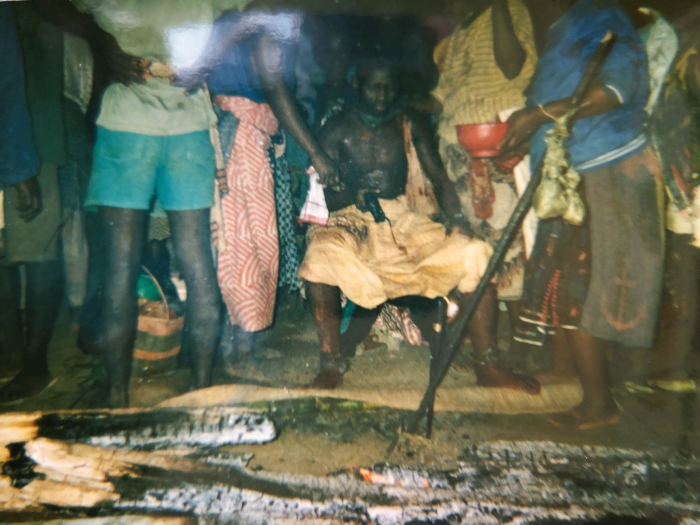
I felt like a child leaving home when my two days in the luxury of the manager's house came to an end and I moved into the cabin for the six tourists allowed in the vast park at any one time. Four were just leaving and were very enthusiastic about their experience. We spent an enjoyable evening together and I met with my travel partner, a young American woman from New York who whilst friendly was reserved and had booked a visit having read about Odzala in National Geographic. We rose early next day to be introduced to our local guide who was to accompany us up the River Lekoli to the northeast boundary of the park. The guide spoke only French, and my companion spoke no French at all, so my smattering of schoolboy phrases was our only unreliable form of communication. We were seated comfortably in a wooden pirogue (canoe) with an outboard motor. We were quickly in dense tropical forest with majestic, often huge girthed, forest trees and no obvious human habitation save the occasional small patch of palm trees showing that people had been there. As we travelled for more than two hours large drops of rain began and I huddled under my thick waterproof army surplus camouflage cape, which was like a steam bath in the dense hot and humid air. We came under attack from Tetsi flies which are the worst insects I had ever come across. Exited by the promise of our blood they kept up intensive sorties. Even my thick cape could not always keep their proboscis at bay. They could penetrate the cape and, if it lay close to the skin, land a strike that felt like a red-hot needle. After more than two hours we arrived at our land destination and sharing out the camping gear and food started up a forest path across more open scenery. We walked for nearly an hour in jovial mood and our guide said that we were nearing our campsite. We turned a bend in the path, moving into open ground, and stopped dead in our tracks. There in front of us, no more than eight metres away, stood a huge male gorilla carefully and delicately picking berries from a bush. We were transfixed by this wonderful full-grown creature oblivious to our presence. It seemed a long and profound time that we watched but must have been less than a minute before he turned his head and registered us with what seemed like a look of shock. He let out a huge scream. I turned to run in panic. "Arrette" the guide barked and I froze. The gorilla was more frightened than us and hurried away into the undergrowth beyond the bush emitting chilling shrieks along the way. We exchanged excited grins along with unbelieving expressions of astonishment. As we were to learn later, lone gorillas were the result of a challenge by a young male to the group's silverback leader. When defeated the looser was pushed out of the group to live alone. Even at this size and power some succumb to the ferocity of leopard attack. We reached camp after a short time, ate and slept. The following day we breakfasted early and set off silently in single file through the forest. At last, we came to the edge of a large clearing covered in green herbs and grasses. There in the middle distance was a huge bull elephant surrounded by bush pigs, bongo, sitatunga and a multitude of smaller animals. Closer, a stream exploded into life as crocodile flew into a murderous spasm, ending the life of smaller creature. Suddenly, the huge bull elephant reared up on its hind legs and spun round and round several times before lumbering off away from us at high speed with its entourage of smaller beasts in tow. There was a more tranquil period in which grazing animals quietly went about their business until we noticed a troop of forest elephants had started to move slowly towards us. We wondered what would happen, but their path took them to the edge of the forest maybe 100 meters to our right and they disappeared into the forest. Our guide explained that elephants had a very keen sense of smell, and he surmised that the bull had smelt our presence. After a short period of gazing, we were interrupted by a crashing sound behind us. As we turned our heads a baby forest elephant emerged from the forest behind us followed closely by its mother. The troop had circled round the forest to enter the clearing again just where we were settled. At this point as we went numb our guide did the bravest thing I had experienced. He jumped up in front of the mother waving his hands and shouting. To our relief the startled troop panicked and fled back into the safety of the forest. We retreated back to camp where our guide received his hero's approbation. Backpacking Index VSO Index Main Index We were fortunate that a young boy of the Lossi tribe was to undertake the circumcision ceremony during our stay. This rite of passage involved a mixture of endurance, magic, dance and feasting in a remote forest village. When we arrived, it was already heading towards dusk and the humid, saturated day was yielding to the chill of the evening. We were shown our basic accommodation, and I greeted one of our base camp cooks who had arrived home to join the celebrations. I noticed that two dry trees had been lain side by side with charcoal alight along the length in the groove formed by the trunks, an ingenious way to keep everybody warm. A tired and distracted young man in his mid-teens was walking around the long thin clearing accompanied by two older male companions. He was not allowed to sleep until the circumcision had taken place. To aid him chilli powder was rubbed into his eyes from time to time. It was their way to transport him into an exhausted trance state ready for the pain to come. He was not allowed to shout or scream through the ordeal if he was to be accepted as a man.
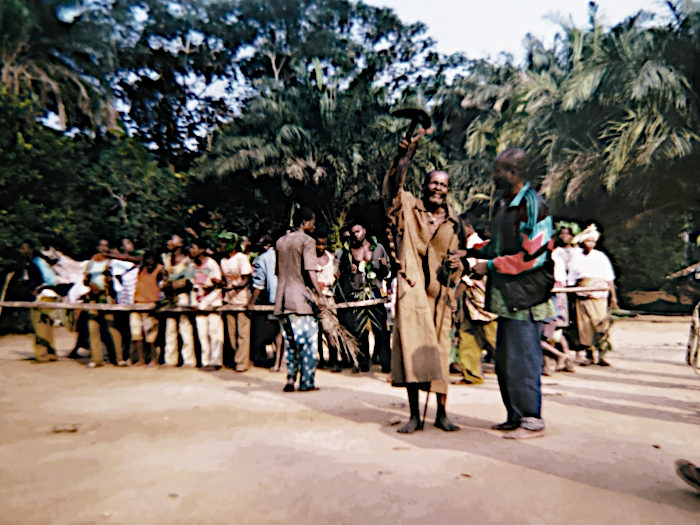
In the evening dancing began around the fire and tributes, including ours, were made to the chief as a mark of respect. The next day was to be the occasion of the circumcision. As afternoon started the population of the village ceremony went to the far end of the clearing to lead the boy down to the circumcision hut. An elegant older man in his 80s I guessed led the procession dancing slowly and rhythmically with walking stick in hand as he progressed down the field followed by the celebrant and village people.
The boy disappeared into the circumcision house, and we waited for the conclusion of the ceremony. We waited for a lengthy period and then finally we were approached by our driver. 'It will not happen today. The elders have discovered that the magic is bad!' It had been discovered that some women had transgressed into the sacred forest which was only for men. This caused the magic to be bad, and it was inauspicious to continue. Somehow it felt right that we should share the build-up but leave the actual moment of circumcision and celebration to the people for whom it was a spiritual event.
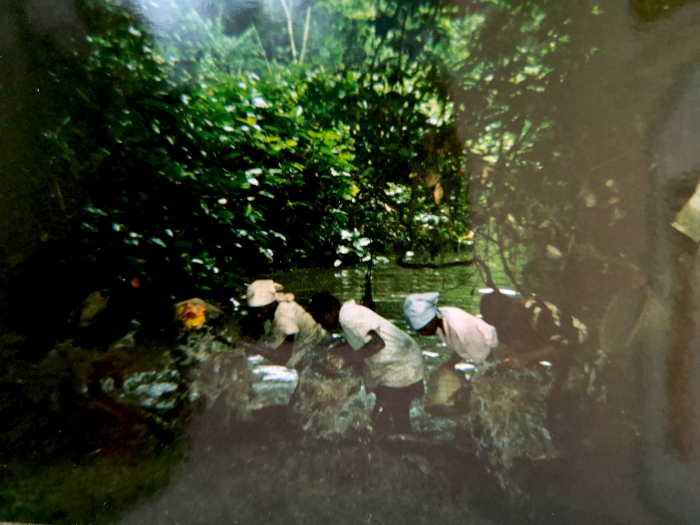
I cannot remember where I came across it but I came across a group of village women, of around 15 women, on the bank of a sizeable stream. As I watched they began to dam the stream with rocks wood and mud. Soon the water was backing up behind it.
As they finished, a second group built another dam some 20 yards further back creating a trapped pool of water. When all was complete women stood in the trapped water close to the dam holding cut down plastic containers which they used to furiously scoop water over the dam to gradually empty the pool. As the water in the dammed pool got to ankle height, they were able to catch any fish trapped. At the end the dam was dismantled. A good example of women as hunters rather than gatherers.
Lengui-Lengui Forest Lowland Gorillas The park was home to a Spanish couple who were the only researchers that had habituated lowland gorillas i.e. made them feel comfortable with the presence of humans in close proximity. The famous film of David Attenborough lying with gorillas was with more amenable highland mountain gorillas. We started with a welcome to their home, a single room in a building rather like a small village hall. Although this had been home for more than 5 years, it was very sparsely furnished. Only the essentials of living and work were visible. I realised for the first time how little we actually needed to support our lives. The two researchers were Dr Magdelana Bermejo and her husband cinematographer German Illera. She became known as the Jane Goodall of eastern lowland gorillas, deeply engaged in the 2002 outbreak of Ebola that killed humans and up to 5,000 gorillas (an estimated 90% of the local gorilla population) After lunch we set out for our first contact with a troop of gorillas. They had been tracked by guides who kept in constant contact with them. It takes 3-5 years to habituate a group by keeping in daily contact. When we came to their clearing there were about 20 adult gorillas with their infants in relaxed mood around a large low spreading tropical tree. Our researchers explained how each day the troop built a nest in the branches of a tree in which the whole troop slept at night. They were very pleased that they had discovered a female who was musical. Communication was common by the beating of chests with cupped hands, but they had found that one female responded to clapped rhythms by clapping the same rhythm in reply. Sure enough, when they clapped a rhythm, the female responded. Back at their bungalow we were treated to tales of gorilla research. The woman described how gorillas are usually fine if the humans remain close to each other, allowing the gorillas to see clearly what they are doing. On one occasion she and the guides had been tracking a troop and came upon them when the humans were spread out. The silver back charged across the clearing towards her screaming loudly. "What did you do?" "I crouched down on haunches with my arms on my head. I could feel his breath on my head. Luckily, he accepted my submissive pose and went back to the troop. It was entirely fault though." ourBefore we sat down to eat German, her husband, excitedly opened his computer to play us a recent recording of a silverback (oldest dominant male) and his mate. It was just like hearing an old married human couple. The female makes some attention seeking high pitched short shrieks. He makes a desultory grunt, as if he is reading his paper and does not want to be disturbed. She repeats the shrieks and he again replies with a single grunt. For a third time she shrieks at him, and he loses his temper and with frighteningly loud voice makes several loud aggressive grunts. She goes silent, chastised. "You know, people think that gorillas are powerful and destructive, but they are very gentle creatures. They will carefully pick up a flower and examine it. A chimpanzee would tear it apart." It was early to bed with a warning that we would be woken before 4 a.m. for an early start. We did our best to be cheerful in the chill dark of the early morning but not very successfully, I fear. We were soon following our 3 guides through mopane forest and thick undergrowth. Having had the easy contact on the first day we not expecting the 2 hours + trek until we made contact with the troop deep in the undergrowth. They were spread out in the forest feeding on fruits and berries but relaxed with our presence as we settled at a reasonable distance in thick forest. We watched the morning routine and, at last, one of our guides asked if we had seen enough. I sensed that he meant that we should leave them alone now and agreed. Mistake. My New Yorker companion, who was not consulted, said nothing but was deeply aggrieved at losing her peak experience. For the rest of the day and until we parted in Brazzaville she did not speak willingly and seethed silently. The next day we were to take a small plane to Brazzaville. Our Spanish hosts decided to use the opportunity to visit the bright lights. They were puzzled by the surliness of the young New York woman, who stood some distance from us. I had arranged to purchase a drum from the local Lossi people. I was expecting a small drum, but a large one appeared. I was worried that it would not be taken but somehow it was strapped to the plane and we were in the air flying over thick forest. The plane was no luxury model. There were only six seats and the pilots sat just in front of us at the controls. After about an hour the pilot said that we had to land to pick up a sick person from a village in the middle of a forest. We came down and bumped along a grass strip to a halt in front of village huts. It seemed that everyone from the village had turned out to greet the plane and see what was going to happen. The pilot disappeared and returned with news that a seat must be removed. He took a spanner to it and created space. Suddenly, the crowd parted in a biblical scene and a woman on a stretcher was carried by several men to the plane, where she was fitted and strapped into the newly created space on the floor. Her husband sat on the only seat left. We bumped along again and took off in front of the waving throng.
As always happens when travelling, Brazzaville was no longer an unknown and intimidating place. I said a fond farewell to the Spanish researchers and watched the New Yorker disappear quickly without even a cursory farewell. At a meal at a reasonable restaurant, I found myself at a table next to a group of French people. I got talking to one of them. "What do you do in Brazzaville?" "I am the economic attaché at the French Embassy." "That sounds like a tough job in such a struggling country." "No, we have over 60% penetration of the market. It would be hard to increase that." With French companies controlling the oil extraction Congo was wrapped up. The evening ended with the purchase of a traditional mask from a man with a bag of masks and there was just one more sleep before negotiating the customs official's disappointed attempt to find non-exportable local currency he could confiscate. Thanks, Congo, for a memorable stay. Since my trip Odzala has become a high end ecotourist destination for gorilla watching. A 9-day visit now costs nearly $7,000-15,000. Let's hope that a reasonable proportion ends up with local people and researchers. It seems that gorilla populations increased over the decade following Ebola losses by moving north into areas of swamp further away from human activity and greed such as increasing logging. |
||
Paul Hague explains. Backpacking Index VSO Index Main Index ***************************
|
||